

What is trigger finger?
It is a common condition in people who bend their fingers repeatedly. The tendons that do this pass under ligaments that hold them in place. At one of these — the A1 pulley, in the palm at the base of each finger — friction causes inflammation, thickening and a local swelling of the tendon. There is pain at that spot and on moving the finger, and a typical sense of "catching" as the swollen tendon jams in the pulley. In severe cases the patient needs the other hand to straighten the finger.

Treatment
Reduced use of the fingers, anti-inflammatories, splints and local cortisone injections are advised. Conservative care often fails, however, and the definitive solution used to be open surgery: an incision in the palm to open the pulley so the tendons move freely. That means an incision, stitches for three weeks, wound care and a delayed return to full activity.
A definitive treatment without an incision
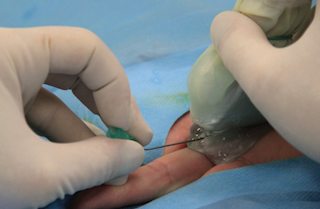
Sonosurgery has a very high success rate, like classic surgery — with the important difference that no incision is made. It is a percutaneous, ultrasound-guided procedure:
- Local anaesthetic.
- The pulley is located with ultrasound.
- A special needle is inserted and divides the pulley.
It is over in 15–20 minutes. A bandage stays on for 24 hours and the finger moves straight away. You can work at a desk within one or two days and do more demanding work within a few days.
Advantages
- No incision — only a needle puncture.
- No stitches and no lengthy wound care.
- Immediate release of the finger.
- A quick return to full activity.
- Can be done in the clinic.
The technique suits every finger except the thumb, where different anatomy means open surgery is needed.
Before the procedure
- You can eat normally.
- Continue your medication, except anti-inflammatories (stop three days before) and anticoagulants (only if your doctor agrees).
- Arrange not to drive home.
After the procedure
- Simple painkillers if needed.
- A bandage for 24 hours; gentle finger movement straight away.
- You can get the hand wet after 48–72 hours.
- Office work and driving in 24–48 hours.
- Demanding manual work in 1–2 weeks.
This information is for general guidance and does not replace a medical consultation. The right treatment is always decided individually, after clinical assessment.


