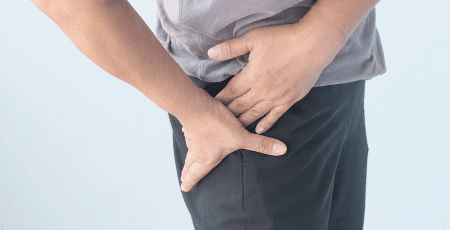
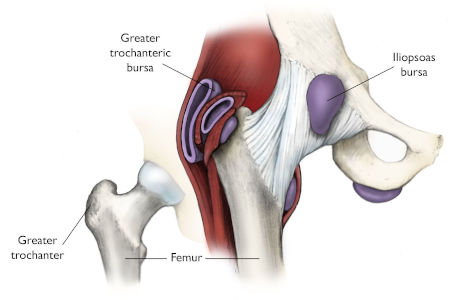
The bone you can feel on the side of your hip is part of the femur called the greater trochanter. Pain in this area is known as trochanteric pain (or trochanteritis): inflammation of the local tendons or bursae (tendinitis, bursitis, or both).
Symptoms
The main symptom is pain on the outside of the hip, around the trochanter, which may spread upwards, backwards or a little downwards. It usually comes on gradually and, less often, suddenly after an injury. The pain is typically worse when lying on that side, climbing stairs or after sport (e.g. running).
Who gets it
It is more common in women and over the age of 30. It typically affects sedentary women over 50, or active people of any age — mainly runners and athletes in sports with changes of direction. It can affect both hips, usually in older women.
Where the problem lies
In one of the local bursae or tendons. Bursae are small sacs that reduce friction between bony prominences, tendons and skin; around the hip they often vary anatomically (beneath gluteus maximus, medius or minimus). Tendinitis, or even torn fibres of the gluteal tendons, often coexists. The iliotibial band may also be involved.
Causes
It can follow a direct blow, but is usually due to repetitive overload — as in sport — or to tendon wear over time. Risk factors include:
- Leg-length difference, true or apparent (e.g. with scoliosis).
- Running in circles in the same direction (track) or on cambered surfaces.
- Trochanters wider than the pelvis.
- Reduced sacral tilt due to anatomy.
- Coexisting piriformis syndrome, hip impingement or hip osteoarthritis.
Outlook
The condition often lasts many months. In studies, a third of patients still have symptoms after one year, and several even after five. Older patients, especially those with osteoarthritis, tend to have the longest course.
Treatment
A combination of measures is needed:
- Activity modification (stopping, reducing or changing how you exercise).
- Pain relief with anti-inflammatories and local cortisone injections.
- Physiotherapy: phonophoresis, TENS, soft-tissue massage.
- An exercise programme stretching the iliotibial band, hip abductors, rotators and flexors.
Newer treatments
Electrolysis is a relatively new and effective way to treat tendinopathies such as trochanteric pain: a very low-intensity continuous current is applied to the damaged area.
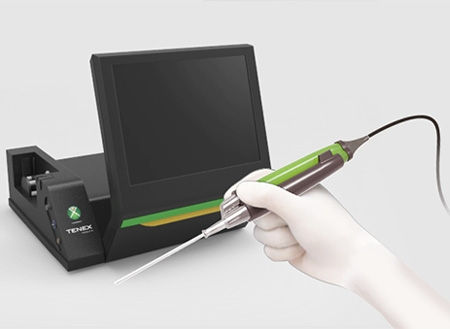
In persistent cases trochanteric pain is treated surgically. Depending on the case, this may involve lengthening the iliotibial band, removing the bursae or repairing the gluteal tendons — through an open incision, arthroscopically or under ultrasound guidance (Sonosurgery).
This information is for general guidance and does not replace a medical consultation. The right treatment is always decided individually, after clinical assessment.